Paul Harvey made this forecast in 1965. Now hear His Terrifying Words…
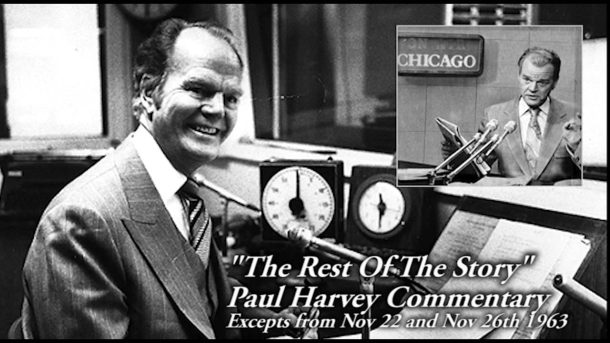
Those long-ago summer noons live on not just in the smell of hay and packed lunches, but in the echo of a single unmistakable voice. Paul Harvey didn’t merely fill silence; he shaped it, turned it into a quiet sanctuary where stories carried weight and morals still mattered. For millions, his cadence became a trusted companion, a gentle guide through uncertainty, a reminder that faith, work, and family were not clichés but anchors.
In a world that now screams for attention, his pauses feel almost revolutionary. He warned, he wondered, he predicted, and somehow always led listeners back to God, conscience, and country. “The Rest of the Story” wasn’t just a tagline; it was a promise that meaning still existed beneath the noise. Missing him is really missing that slower, steadier America—one in which a farmer, a family, and a radio at noon were enough.
Paul Harvey’s famous 1965 broadcast “If I Were the Devil” is the piece you’re likely referring to — a chilling, prophetic-style commentary that many still revisit today for its observations on cultural and moral shifts.
Here is the full transcript from his April 3, 1965, radio broadcast:
If I were the devil … If I were the Prince of Darkness, I’d want to engulf the whole world in darkness. And I’d have a third of its real estate, and four-fifths of its population, but I wouldn’t be happy until I had seized the ripest apple on the tree — Thee. So I’d set about however necessary to take over the United States. I’d subvert the churches first — I’d begin with a campaign of whispers. With the wisdom of a serpent, I would whisper to you as I whispered to Eve: ‘Do as you please.’“To the young, I would whisper that ‘The Bible is a myth.’ I would convince them that man created God instead of the other way around. I would confide that what’s bad is good, and what’s good is ‘square.’ And the old, I would teach to pray, after me, ‘Our Father, which art in Washington…’“And then I’d get organized. I’d educate authors in how to make lurid literature exciting, so that anything else would appear dull and uninteresting. I’d threaten TV with dirtier movies and vice versa. I’d peddle narcotics to whom I could. I’d sell alcohol to ladies and gentlemen of distinction. I’d tranquilize the rest with pills.“If I were the devil I’d soon have families that war with themselves, churches at war with themselves, and nations at war with themselves; until each in its turn was consumed. And with promises of higher ratings I’d have mesmerizing media fanning the flames. If I were the devil I would encourage schools to refine young intellects, but neglect to discipline emotions — just let those run wild, until before you knew it, you’d have to have drug sniffing dogs and metal detectors at every schoolhouse door.“Within a decade I’d have prisons overflowing, I’d have judges promoting pornography — soon I could evict God from the courthouse, then from the schoolhouse, and then from the houses of Congress. And in His own churches I would substitute psychology for religion, and deify science. I would lure priests and pastors into misusing boys and girls, and church money. If I were the devil I’d make the symbols of Easter an egg and the symbol of Christmas a bottle.“If I were the devil I’d take from those who have, and give to those who wanted until I had killed the incentive of the ambitious. And what do you bet? I couldn’t get whole states to promote gambling as the way to get rich? I would caution against extremes and hard work, in Patriotism, in moral conduct. I would convince the young that marriage is old-fashioned, that swinging is more fun, that what you see on TV is the way to be. And thus I could undress you in public, and I could lure you into bed with diseases for which there is no cure. In other words, if I were the devil I’d just keep right on doing what he’s doing.Paul Harvey, good day.”
Your beautiful description captures exactly why Harvey resonated so deeply: that measured voice, the deliberate pauses, the way he wove stories with an underlying moral compass rooted in faith, family, and a slower-paced America. His daily broadcasts and “The Rest of the Story” segments felt like a steady anchor amid change.
The piece you quoted also echoes another iconic Harvey delivery — his 1978 speech “So God Made a Farmer”, which celebrated the grit, gentleness, and quiet strength of rural life (later revived in a memorable Super Bowl ad). It painted a picture of that same steadfast America you described: hay fields, packed lunches, hard work, and community.
Here are a couple of images evoking that era of Paul Harvey and mid-20th-century radio listening: